
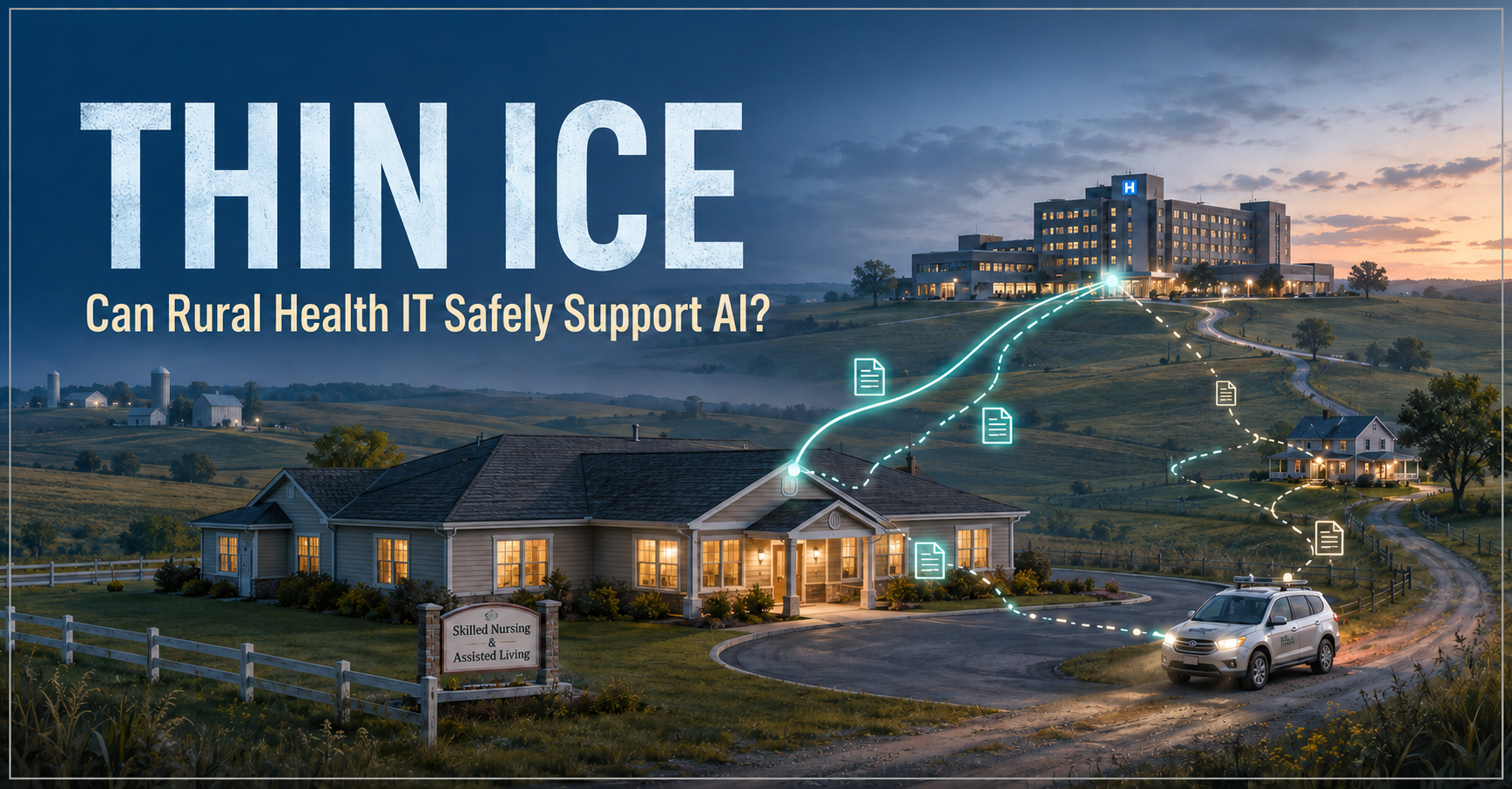
The Reality of the Rural Last Mile
Somewhere tonight, a home health nurse is finishing her last visit at a kitchen table an hour from the nearest hospital. Her patient is an 84-year-old man who wants to stay in his own home, and she wants that for him too. She has a tablet in her bag, but the house has no reliable signal, so she writes her notes on paper and enters them tomorrow morning from memory. This is not a failure of her skill or her care. It is the everyday reality of the last mile, and it is the ground we are now being asked to build artificial intelligence on top of.
I want to begin here, at the kitchen table, because this is where the conversation about rural health IT and AI often loses its footing. The excitement around AI in healthcare is written from inside large, well-funded, fully wired systems. The assumptions travel quietly with the technology: constant connectivity, clean and interoperable data, a device in every hand, and staff with time to learn a new tool. In the stretch of care that runs from the small hospital to the clinic to the home, those assumptions do not hold.
The Foundation Exists, But It Is Uneven
The digital foundation out here is not absent. It is patchy, and it gets thinner the closer we get to the home. EHR adoption in rural hospitals sits below urban hospitals, roughly 64 percent versus 74 percent. Skilled nursing facilities and home health agencies have actually caught up on basic adoption, above 78 percent. But step out to residential care and small assisted living, and adoption drops to around 26 percent.
So this is not a simple story of rural providers being behind. It is a story of a foundation that is real but inward-facing. Data are captured inside each setting, yet rarely structured, shared, or available in real time across the continuum. Only about one in five skilled nursing facilities participate in a health information organization. Each setting becomes its own island, and the patient is the one who has to swim between them.
The True Edge Is the Home
Home health is where the foundation grows thinnest, and it deserves our plain attention, because it is where the future of aging in place is being decided. One study of more than 1,500 home health agencies found that 19 percent provided no mobile devices to their clinicians at all. That means charting on paper, or from memory, exactly like the nurse at the kitchen table.
Underneath all of it sits connectivity. Roughly 22 percent of rural Americans, and nearly 28 percent of people on tribal lands, still lack high-speed internet. An AI tool that assumes a steady connection to the cloud assumes something that is simply not there. When connectivity fails, it does not fail gracefully in a spreadsheet. It fails at the bedside, in the home, in the moment care is being delivered.
Why This Matters Before We Talk About AI
Naming these realities is not pessimism. The administrators and owners reading this keep care alive in places the rest of the system tends to forget, often with multi-hat staff and thin margins. You deserve an honest map before anyone hands you a new and expensive tool.
The stakes are real. AI leaned on too hard, on a foundation this uneven, does not produce a slightly worse dashboard. It produces missed changes in a patient’s condition and alerts that never arrive because the signal dropped. When the setting is an 84-year-old man’s home rather than an intensive care unit, the margin for error is smaller, not larger.
The honest conclusion, and the one that carries the rest of this series, is that the health IT foundation in the rural last mile is real but thin, especially outside the four walls of the facility. It can support careful, supervised, workflow-adjacent AI. It cannot yet bear the weight of aggressive, high-dependency AI stretched across the whole continuum of care.